

Bold, agile HR services That support your most valuable asset.
your people.
Straight talking, no nonsense HR that goes beyond templates and helplines so you can focus on growing your business with confidence.
BLOG
What You Need to Know About the Employment Rights Bill Roadmap
What You Need to Know About the Employment Rights Bill Roadmap
A raft of changes are coming to UK employment law between 2024 and 2027. Here's a quick guide to what's changing - and what SMEs need to do now to be ready.
The Government has just released its Employment Rights Bill Roadmap, which outlines what’s coming up in employment law over the next 12 to 18 months. If you’re running an SME there will be some changes to get to grips with, especially when it comes to policies, contracts, staff leave and planning ahead with your team.
With finding and retaining great people already a challenge, getting to grips with what’s coming can make a real difference and help you stay ahead of the game.
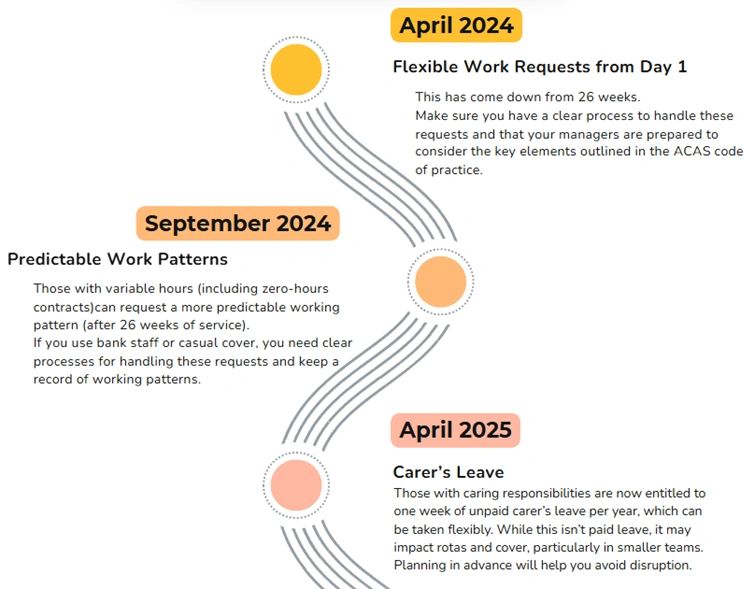
What’s Already in Place?
What’s Coming?
More access to sick pay from April 2026:
No more lower earnings limit or 3 day waiting period = everyone gets SSP from day 1 of absence. This could mean an increase in sick pay costs, less incentive to return to work quickly and an increase in absenteeism.
BUT it could also mean less presenteeism, which means reduced spread of infectious diseases and quicker recovery because your people will actually rest properly and at the right time.
What can you do?:
Review your absence policy and get on top of your absence management processes, make sure managers understand that these changes are coming and they can’t rely on people turning up for work just because they can’t afford a sick day.
There will likely be some extra cost, so look at your absence rates (in number of days) and make sure it’s considered in your next budget.
No more fire and rehire from October 2026:
It will be automatically unfair to dismiss an employee for refusing any variation to their contract of employment. Also you will no longer be able to rehire them under a varied contract for almost the same role.
The good news is that a new amendment has just been released meaning this will only apply to significant changes, or a ‘restricted variation’. This would be any change that affects pay, pensions, working hours/patterns, or time off.
Changes that fall outside of ‘restriction’ include changes to an employee’s place of work or duties, or the introduction of a new disciplinary policy.
What can you do?:
Consult with people, give them plenty of notice and try to come to an agreement, particularly for restricted variations. Keep a record of discussions!
Flexible working and zero hours contracts from 2027:
Flexible working can already be requested from day 1. The roadmap intends to allow employment tribunals to consider whether it was reasonable for an employer to decide to reject a request. The intention is to encourage careful consideration of requests and enhanced access to flexible working.
For workers on zero hours contracts, after 12 weeks they can request guaranteed hours, bringing some stability to work patterns. In return the Bill will ‘compel’ an employer to provide this guarantee. This has been watered down from the original proposal whereby you would have to offer those hours regardless, in recognition that some workers prefer more flexibility.
What can you do?:
Make sure you have a clear process to handle flexible working requests and that your managers are prepared to consider key elements, which are outlined by ACAShere. If hybrid working has become normal practice for you, it might be a good idea to formalise those hybrid arrangements.
If you are prepared to manage a flexible working environment, these changes won’t be an issue. If a flexible working environment isn’t possible for you, make sure you communicate this to your workforce, and that they understand why.
For zero hours contracts, review your contracts and make sure they include reasonable notice periods for setting, changing and cancelling shifts.
Make sure you are respecting the rights of your workforce, talk to them about their rights, give them channels to request changes or guarantees. This could be a good thing for morale and provide intervention before concerns become disputes.
Unfair dismissal protections from 2027:
Although this is being reported as a ‘Day 1’ right, there will likely still be a period of time before the rights apply, this could be a 6 month qualifying period (down from 2 years) or a 9 month probationary period. The details are still in consultation.
What can you do?:
Good. Hiring. Practices. Be clear on what you want when you hire. Once they start, use their probation to assess them against these needs, regularly reviewing and communicating. Then pass or fail probation accordingly. It really is that straightforward… start now!
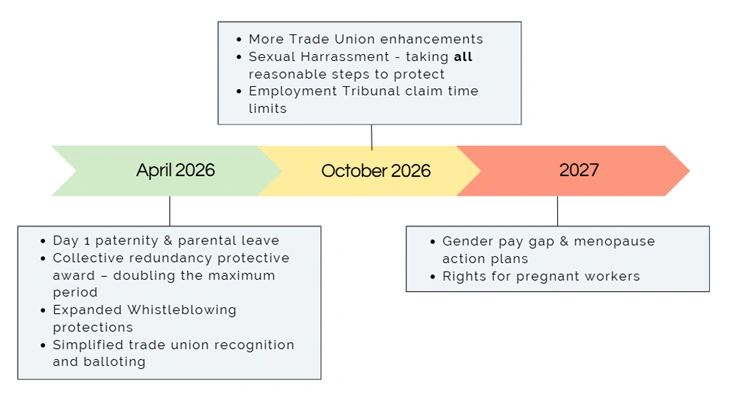
What Else?
Here are some other key elements upcoming:
So What?
Preparation is key!
There’s an underlying theme here. If your house is in order, none of these changes will have a devastating impact on your business.
If you have good managers and leaders, these changes will merely reflect what they are already doing.
If you have up to date, clear policies, everyone will know who is entitled to what, and when.
Most importantly - communicate. Everyone needs to know what is coming with plenty of notice, no surprises.
We can help
What are you most worried about?
Not sure where to start?
We’re already partnering with clients to prepare. Not just to stay compliant, but to build smarter, more resilient people strategies for the year ahead.
If you’d like support navigating these changes in a way that works for your business and your team, we’d love to help.

Our Trusted Partners
Our Trusted Partners















Ready to take the next step?
Our values and promise

COMPANY
HOME
ABOUT US
OUR SERVICES
CONTACT US
OPENING HOURS
Mon 09:00 – 17:30
Tue 09:00 – 17:30
Wed 09:00 – 17:30
Thu 09:00 – 17:30
Fri 09:00 – 17:00
Sat Closed
Sun Closed
CHILDCARE HR
5 Torbay, Quainton,
Buckinghamshire,
hp22 4ax,
United Kingdom


EMHR LIMITED COMPANY NO. 15511686
© Copyright 2026. Childcare HR. All Rights Reserved.